
 国际站
国际站 
在学术会议(如 IEEE、ACM 或 CCF 推荐会议)的投稿流程中,当作者收到包含修改意见的决议信(Decision Letter,通常标注为 Accept with Minor Revision 或 Revise and Resubmit)时,这意味着您的论文已经成功跨越了最艰难的初筛门槛。
然而,收到修改通知不等于最终录用。 如果回复信(Response Letter / Rebuttal Letter)撰写方式得不偿失、态度傲慢或对审稿人的核心质疑避重就轻,文章依然有可能在终稿审查(Final Review)环节被程序委员会(TPC)否决。
一份专业的回复信不仅是学术能力的展现,更是严谨学术态度的契约。以下为您梳理回复信撰写的核心原则、标准架构与高分话术。
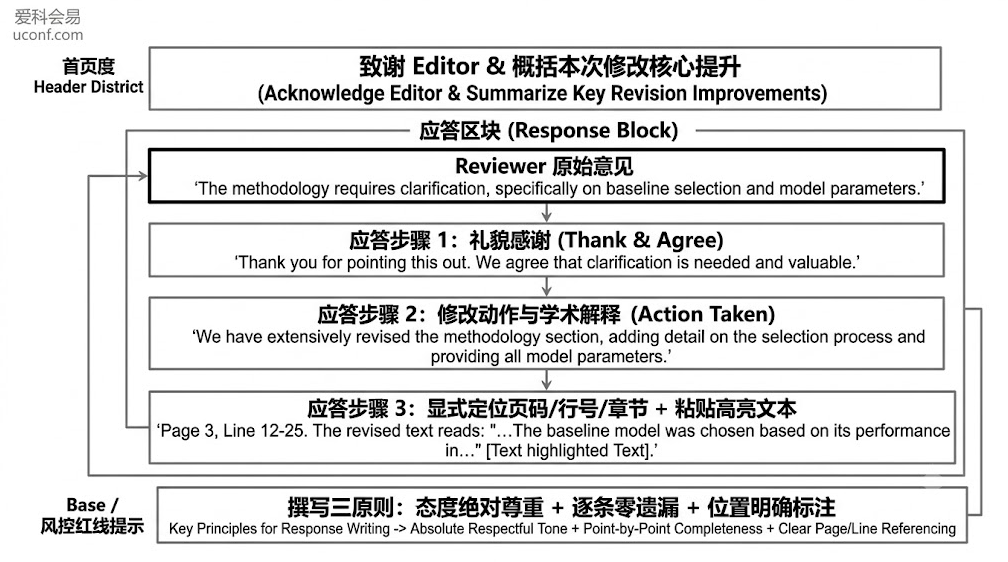
一、 撰写回复信(Response Letter)的黄金三原则
在动笔撰写具体内容之前,必须时刻牢记以下三条底层沟通法则:
-
绝对礼貌与尊重的态度(Polite & Respectful):
-
无论审稿人的评语多么挑剔甚至存在明显的误解,切忌在回复信中流露情绪化言语。时刻使用尊重学术同行的专业语气(如 "We sincerely thank the reviewer for this constructive suggestion.")。
-
-
逐条无遗漏的精准应答(Point-by-Point & Complete):
-
必须将 Decision Letter 中每一位审稿人(Reviewer #1, Reviewer #2...)的所有意见原封不动地逐条复制出来,并在下方逐一作答。严禁漏掉任何一个问题或自行合并审稿人的质问。
-
-
显式标注修改位置(Clear Signposting):
-
每一个修改点都必须明确指出在论文终稿(Camera-Ready / Revised Version)中的具体页码、章节与行号(例如:Page 4, Section III-B, Lines 12-18),甚至将修改后的最新段落文字用高亮(Highlight)形式直接粘贴在回复信中,最大程度降低审稿人的二次核查成本。
-
二、 回复信的标准三段式架构
一份规范的回复信应当具备清晰的层级结构:
1. 开篇致谢与总结(Header & General Response)
-
内容要点:抬头致信给 Editor 或 Program Committee Chairs,对审稿人的辛苦付出表示感谢,并用 2-3 句话简要概括本次修改的核心提升(如补充了 Baseline 对比实验、修正了理论证明或重构了图表)。
2. 逐条详细应答主体(Point-by-Point Responses)
-
标准应答三部曲:
-
第一步:表达感谢与认同(Thank the reviewer...)
-
第二步:阐述具体修改动作或学术解释(We have revised/added/clarified...)
-
第三步:展示修改后的最新文本与位置(The revised text in Section XX reads as follows...)
-
3. 结尾结语(Sign-off)
-
内容要点:表达期待与进一步修改的开放态度(例如:"We hope these revisions address all the concerns. We remain at your disposal for any further improvements.")。
三、 面对不同审稿场景的高分应答话术
在实际回复过程中,作者通常会遇到以下三种典型场景:
场景一:审稿人提出了非常建设性的修改意见,且您完全照办
-
合规话术:
"We express our sincere gratitude to the reviewer for this insightful comment. We completely agree that including a computational complexity comparison would strengthen the paper. As suggested, we have added a detailed complexity analysis in Table II and discussed the runtime performance in Section IV-C (Page 5, Lines 21-35)."
场景二:审稿人要求补充极耗时的大型实验,但会议终稿时间/页数受限
-
合规话术(切忌生硬拒绝,应展现已做的工作与物理局限):
"Thank you for pointing out this important aspect. While a full cross-dataset evaluation across all 10 public benchmarks would be highly valuable, due to the strict 6-page limitation for conference submission, we have prioritized adding the two most representative datasets (Dataset A and B) in Section V-B. We have also added a paragraph discussing this limitation in Section VI."
场景三:审稿人对某个理论或算法产生了明显误解(您认为自己没错)
-
合规话术(将责任归咎于自己原稿表述不清,而非审稿人智商):
"We appreciate the reviewer bringing this to our attention. We apologize for the lack of clarity in our initial formulation, which may have led to this misunderstanding. To clarify, our proposed model does not assume zero-noise conditions because [Explanation]. We have rewritten Section III-A (Page 3) to render this definition completely unambiguous."