
 国际站

撰写合作类 SCI、EI 期刊或国际会议论文时,明确了共同第一作者(Co-first Author)的归属后,下一步最容易出错的环节就是标题页排版与代码实现。不同出版商对上标符号、脚注宏包指令的要求各不相同,一旦写错不仅会在形式审查(Technical Check)阶段被打回,更可能在见刊排版时被遗漏共一标识,导致后续毕业审核或职称认定受阻。
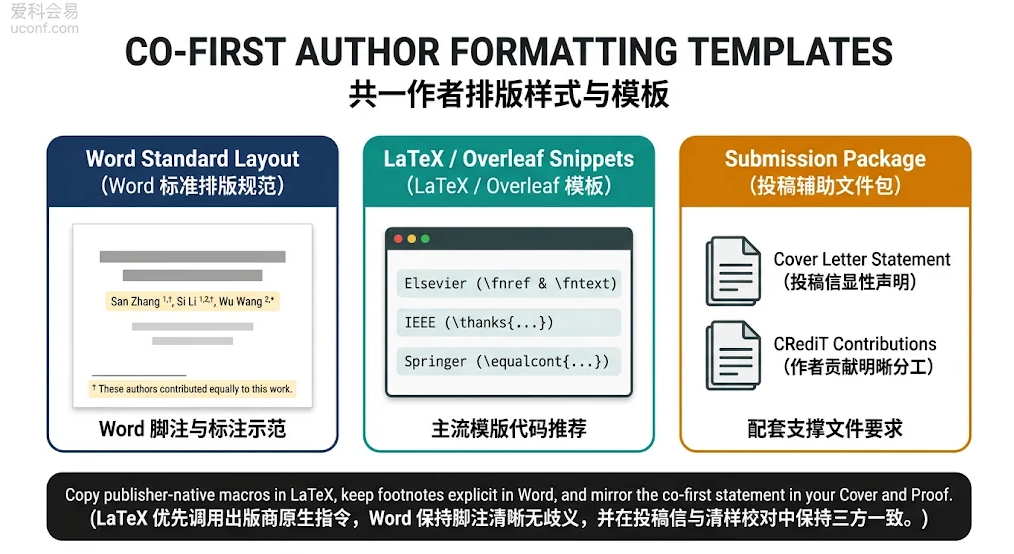
下文为您整理了覆盖 Word 通用标题页、四大主流出版商 LaTeX 源码、多场景英文脚注句式以及配套 Cover Letter / CRediT 声明 的全套标准模板,按需替换姓名与单位即可直接使用。
1. 通用 Word 论文标题页模板(百搭常规 SCI 期刊)
如果目标期刊未提供极其特殊的作者栏排版样例,使用 Word 投稿时,采用“数字标单位 + 剑号 †(或井号 #)标共一 + 星号 * 标通讯”是最稳妥、编辑部识别度最高的国际通用模板:
Title of Your Manuscript Goes Here

San Zhang 1,†, Si Li 1,2,†, Zhao Liu 2, and Wu Wang 1,*

1 School of Computer Science, University A, Beijing 100000, China
2 Department of Electronic Engineering, University B, Shanghai 200000, China

† These authors contributed equally to this work and should be considered co-first authors.
* Corresponding author: Wu Wang (E-mail: [email protected])
Word 排版操作提示:
-
将姓名后的
1,†、1,2,†与1,*选中,按快捷键Ctrl + Shift + =(Mac 为Command + Shift + =)设为上标。 -
切勿直接使用 Word 菜单栏的“引用 → 插入脚注”功能来生成作者脚注,否则极易与正文注释编号冲突或导致双栏排版错位;直接在单位地址下方空一行,以小一号字体手动排版
†和*说明行即可。
2. 四大主流出版商 LaTeX (Overleaf) 原生源码模板
在使用 Overleaf 排版时,切忌用生硬的手动数学上标覆盖出版商自带的宏包逻辑,而应优先调用官方 .cls 样式文件内置的专属命令,确保后台 XML 元数据抓取准确无误。
① Elsevier 期刊模板(elsarticle.cls)
Elsevier 模板内置了 \fnref(脚注引用)与 \fntext(脚注正文)指令,能自动生成规范的编号与首页左下角脚注:
\author[1]{San Zhang\fnref{fn1}}
\author[1,2]{Si Li\fnref{fn1}}
\author[1]{Wu Wang\corref{cor1}}
\ead{[email protected]}

\affiliation[1]{organization={School of Computer Science, University A},
                city={Beijing},
                postcode={100000},
                country={China}}
\affiliation[2]{organization={Department of Electronic Engineering, University B},
                city={Shanghai},
                postcode={200000},
                country={China}}

\fntext[fn1]{These authors contributed equally to this work.}
\cortext[cor1]{Corresponding author.}
② IEEE 期刊与会议模板(IEEEtran.cls)
IEEE 严格规范不在作者姓名右上角堆砌任何数字或星号,所有共一与通讯说明必须统一写入 \thanks{...} 模块中:
\author{San Zhang,~\IEEEmembership{Student Member,~IEEE,}
        Si Li,
        and Wu Wang,~\IEEEmembership{Senior Member,~IEEE}%
\thanks{Manuscript received November 20, 2026. This work was supported by the National Natural Science Foundation of China under Grant XXXXXXXX. (San Zhang and Si Li contributed equally to this work.) (Corresponding author: Wu Wang.)}
\thanks{San Zhang and Wu Wang are with the School of Computer Science, University A, Beijing 100000, China (e-mail: [email protected]; [email protected]).}
\thanks{Si Li is with the Department of Electronic Engineering, University B, Shanghai 200000, China (e-mail: [email protected]).}}
③ Springer Nature 期刊模板(sn-jnl.cls)
Springer Nature 最新官方模板直接提供了原生的 \equalcont{...} 指令,只需紧跟在每一位共同第一作者条目下方即可:
\author[1]{\fnm{San} \sur{Zhang}}\email{[email protected]}
\equalcont{These authors contributed equally to this work.}

\author[2]{\fnm{Si} \sur{Li}}\email{[email protected]}
\equalcont{These authors contributed equally to this work.}

\author*[1]{\fnm{Wu} \sur{Wang}}\email{[email protected]}

\affil[1]{\orgdiv{School of Computer Science}, \orgname{University A}, \orgaddress{\city{Beijing}, \postcode{100000}, \country{China}}}
\affil[2]{\orgdiv{Department of Electronic Engineering}, \orgname{University B}, \orgaddress{\city{Shanghai}, \postcode{200000}, \country{China}}}
④ ACM 国际会议模板(acmart.cls)
ACM 会议模板(如 SIGCOMM、KDD、CHI、MM 等)使用 \authornote 配合 \authornotemark[1] 复用同一条共一脚注:
\author{San Zhang}
\authornote{Both authors contributed equally to this research.}
\email{[email protected]}
\affiliation{%
  \institution{University A}
  \city{Beijing}
  \country{China}
}

\author{Si Li}
\authornotemark[1]
\email{[email protected]}
\affiliation{%
  \institution{University B}
  \city{Shanghai}
  \country{China}
}

\author{Wu Wang}
\authornote{Corresponding author.}
\email{[email protected]}
\affiliation{%
  \institution{University A}
  \city{Beijing}
  \country{China}
}
3. 不同场景标准英文脚注句式速查表
根据国内高校审核要求或合著结构的复杂程度,可直接从下表选用最匹配的英文声明句式:
| 适用署名场景 | 标准英文脚注模板(直接套用) | 选用建议 |
| 标准简洁版(2 人共一) | † These authors contributed equally to this work. |
最符合 Nature、Science 及多数老牌 SCI 期刊的精炼风格。 |
| 点名防歧义版(强烈推荐) | † San Zhang and Si Li contributed equally to this work and should be considered co-first authors. |
直接列出具体姓名与 co-first authors 字样,最便于国内研究生院与人事处核验,杜绝任何理解争议。 |
| 3 人及以上共同第一作者 | † San Zhang, Si Li, and Zhao Liu contributed equally to this work. |
适用于大型实验或跨院系多中心联合研究;注意核实本单位是否承认共一第三位。 |
| 共同第一作者兼任通讯作者 | 作者栏标 San Zhang 1,†,*;脚注分别写明 †(共一)与 *(通讯)两行说明。 |
常见于青年教师或博士后独立牵头合作项目,两个上标符号用英文逗号隔开即可。 |
| 双盲审稿匿名版(Double-Blind) | 审稿阶段标题页直接写 Anonymous Author(s),彻底隐藏所有共一及通讯信息。 |
投递 NeurIPS、CVPR、ACL 等双盲顶会时,严禁在审稿 PDF 中暴露姓名或单位脚注,录用后提交 Camera-Ready 时再恢复模板。 |
4. 配套必备模板:Cover Letter 与 CRediT 贡献声明
目前绝大多数投稿系统(如 Editorial Manager、ScholarOne)在网页端填写作者表单时,并没有专门勾选“共同第一作者”的复选框。为了防止系统自动生成的元数据遗漏共一信息,务必在以下两份配套文件中同步声明:
① Cover Letter(投稿信)声明段落模板
在投稿信结尾的合规声明段落中加入以下一句:
Please note that San Zhang and Si Li contributed equally to this work and share first authorship. All authors have read and approved the final version of the manuscript and agree with the order of authorship.
② CRediT Author Statement(作者贡献声明)模板
如今 Elsevier、Wiley、Springer 等出版商普遍要求在文末附上 CRediT 角色分工。如果标了共同第一作者,两位共一的贡献条目必须体现出实质性且旗鼓相当的核心工作量(例如一方主攻算法与建模,另一方主攻实验验证与数据分析,且共同参与初稿撰写),切忌出现“一作干了全部活、共一二作只负责可视化”的失衡写法:
CRediT authorship contribution statement
San Zhang: Conceptualization, Methodology, Software, Validation, Formal analysis, Writing – original draft.
Si Li: Conceptualization, Methodology, Data curation, Investigation, Visualization, Writing – original draft.
Wu Wang: Supervision, Project administration, Funding acquisition, Writing – review & editing.
5. 套用模板时的三个实操防雷细节
-
LaTeX 特殊符号转义防报错:若使用非标准模板手动输入上标符号,剑号
†应写成$^{\dagger}$,星号*写成$^{*}$,井号#必须加反斜杠写成$^{\#}$(直接写#会触发 LaTeX 宏参数编译报错)。 -
确保作者顺序与共一符号逻辑自洽:标注为共同第一作者的姓名必须连续排列在作者列表的最前端(第 1 位、第 2 位),绝不能出现“第 1 位和第 4 位标为共同第一作者、中间夹着普通合作者”的违规排法。
-
清样校对(Proof)阶段务必二次核验:即便投稿时严格套用了上述 Word 或 LaTeX 模板,在论文接收后进入出版商外包排版环节时,仍偶发出现排版员遗漏
†符号或误删contributed equally脚注的情况。收到校样确认邮件后,请第一时间重点放大检查论文首页的作者右上角标记与页脚文字,发现缺失立即批注要求补全,避免正式见刊后陷入漫长的勘误流程。
直接按目标出版商对应套用上述标准模板,并将正文标题页、投稿信声明与 CRediT 贡献分工三者严格对齐,既能确保论文顺利通过编辑部的格式审查,也能为后续的成果认定留存无可挑剔的出版凭证。