
 国际站
国际站 
在撰写英文学术论文(如SCI、SSCI、EI等)时,很多母语非英语的学者常常感到词汇匮乏,写出来的句子生硬、不连贯,充满了“Chinglish(中式英语)”的味道。
其实,高水平的学术英语并不在于使用了多么冷僻的单词,而在于逻辑结构的严密和过渡表达的自然。本文为您分类整理了英文学术写作中最常用、最地道的高频句型和连接词,强烈建议您收藏备用,在写作卡壳时随时查阅。
一、 引言与背景陈述句型 (Introduction & Background)
引言的目的是确立研究领域的背景和重要性。
-
强调研究重要性:
-
Recent developments in [领域] have heightened the need for... (近年来[领域]的发展凸显了对...的需求。)
-
[研究主题] has become a central issue in... ([研究主题]已成为...的核心问题。)
-
It is now well established that... (目前已经公认的是...)
-
-
指出已有研究的不足(找 Gap):
-
However, far too little attention has been paid to... (然而,对...的关注依然太少。)
-
To date, there has been no reliable evidence that... (迄今为止,尚无可靠证据表明...)
-
Previous studies have failed to consider... (先前的研究未能考虑到...)
-
-
陈述本研究的目的:
-
The main objective of this paper is to investigate... (本文的主要目的是调查...)
-
This study systematically reviews the data for... (本研究系统地回顾了关于...的数据。)
-
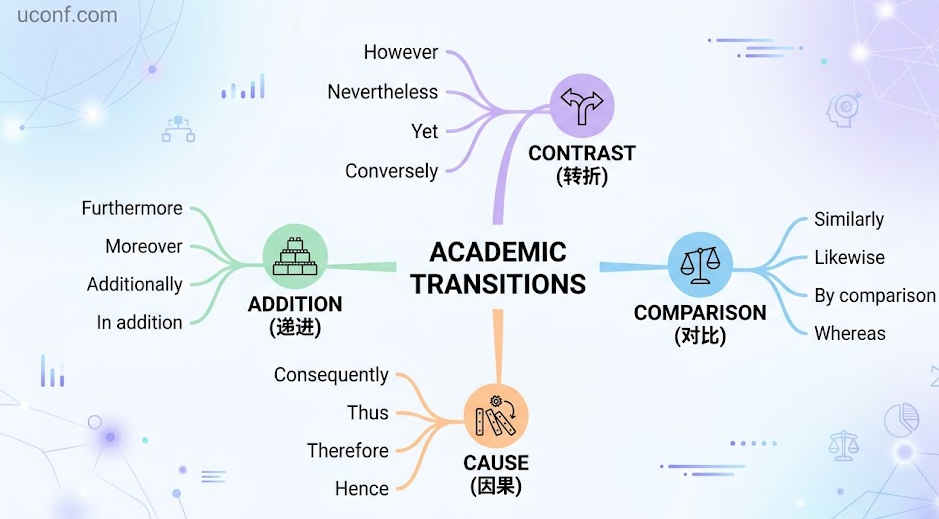
二、 逻辑连接词与过渡句型 (Transitions & Connectors)
清晰的逻辑是学术论文的灵魂,而连接词就是串联逻辑的骨架。
-
表示递进与补充 (Addition):
-
Furthermore, / Moreover, / Additionally, (此外 / 而且 / 另外)
-
Along with this growth in..., there is increasing concern over... (随着...的增长,人们对...的关注日益增加。)
-
-
表示转折与让步 (Contrast & Concession):
-
In contrast to earlier findings, however, ... (然而,与早期的发现相反,...)
-
Despite the importance of [A], [B] remains... (尽管[A]很重要,但[B]仍然...)
-
While it is generally agreed that..., there is less consensus on... (虽然人们普遍认为...,但在...上的共识较少。)
-
-
表示因果与推论 (Cause & Effect):
-
Consequently, / Thus, / Therefore, (因此 / 所以)
-
This discrepancy could be attributed to... (这种差异可能归因于...)
-
A direct consequence of this is... (这带来的一个直接后果是...)
-
三、 对比分析与讨论句型 (Comparison & Discussion)
在结果与讨论部分,您需要将自己的发现与前人进行对比。
-
表示一致与相似 (Similarities):
-
This finding is consistent with that of Smith (2020) who... (这一发现与Smith(2020)的研究一致,他...)
-
Similar to the results obtained in..., we found that... (与在...中获得的结果类似,我们发现...)
-
These results further support the idea of... (这些结果进一步支持了...的观点。)
-
-
表示差异与不同 (Differences):
-
Unlike the approach used by Jones et al., our method... (不同于Jones等人使用的方法,我们的方法...)
-
On the other hand, the present study observed... (另一方面,本研究观察到...)
-
There is a significant difference between A and B in terms of... (在...方面,A和B之间存在显著差异。)
-
-
解释意想不到的发现 (Explaining unexpected results):
-
It is somewhat surprising that... (令人有些惊讶的是...)
-
One possible explanation for this unexpected result is... (对这一意外结果的一种可能解释是...)
-
四、 结论与未来展望句型 (Conclusion & Future Work)
结论部分需要强有力地概括全文贡献并展望未来。
-
重申核心发现:
-
In conclusion, this study has shown that... (总之,本研究表明...)
-
The most obvious finding to emerge from this study is that... (本研究得出最明显的发现是...)
-
Returning to the question posed at the beginning of this study, it is now possible to state that... (回到本研究开始时提出的问题,现在可以断言...)
-
-
强调研究的意义与应用:
-
These findings have significant implications for the understanding of how... (这些发现对理解如何...具有重要意义。)
-
The proposed method can be directly applied to... (所提出的方法可直接应用于...)
-
-
指出局限性与未来方向:
-
A limitation of this study is that... (本研究的一个局限性是...)
-
Further research should be undertaken to investigate the... (未来的研究应致力于调查...)
-
More broadly, research is also needed to determine... (更广泛地说,还需要研究来确定...)
-
总结: 熟练掌握这些高频学术句型,不仅能大大加快您的写作速度,还能让审稿人感受到您文字背后的专业素养。建议您在日常阅读文献时,也建立自己的“语料库”,不断积累地道的英文学术表达。